| Product Model |
LX-SG801 |
LX-SG801-POE |
| Fixed Ports |
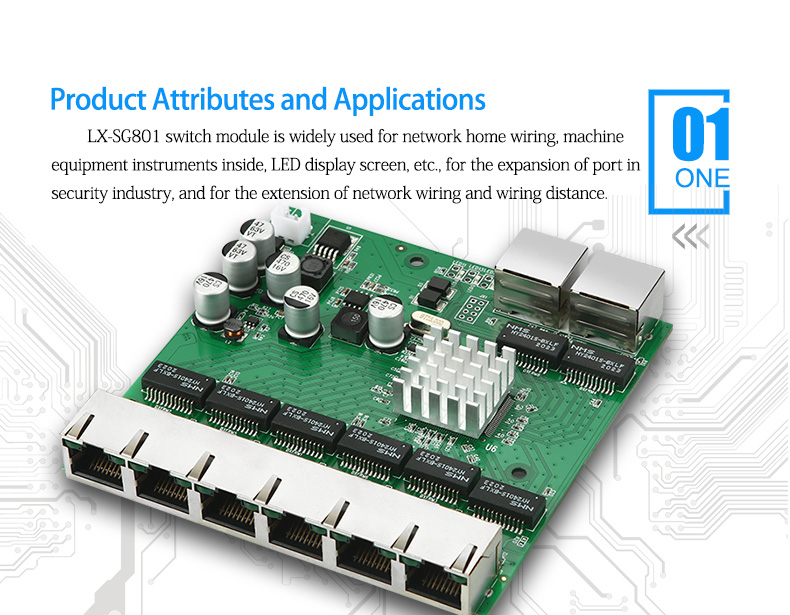
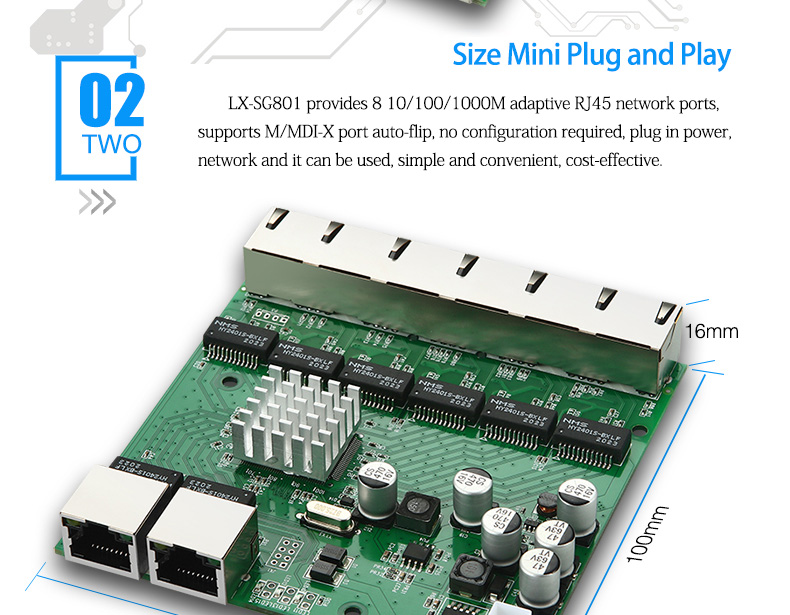
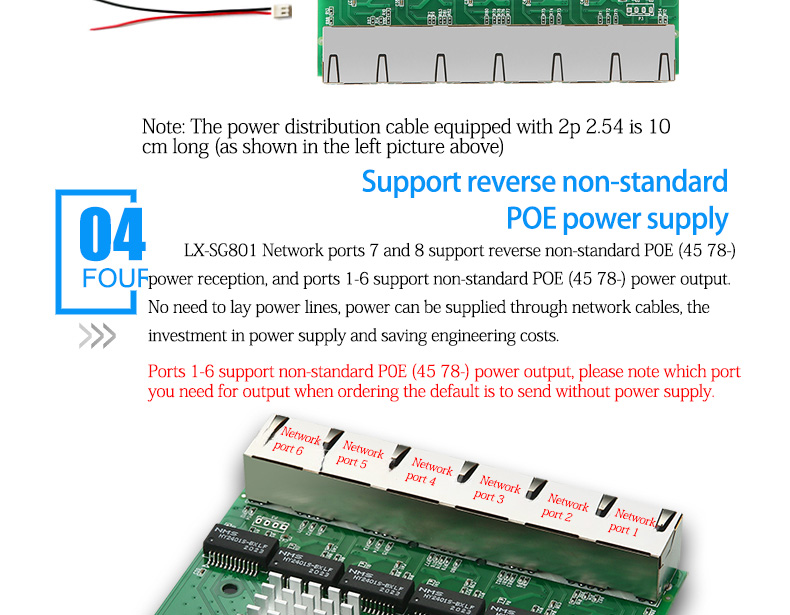
6 x 10/100/1000Base-T POE ports (Data/Power)
2 x 10/100/1000Base-T uplink electrical ports (Data) |
|
| POE Ports |
1-6 ports support IEEE802.3af/at standard PoE power supply |
|
| Network Protocols |
IEEE802.3 10BASE-T;
IEEE802.3i 10Base-T;
IEEE802.3u 100Base-TX;
IEEE802.3ab 1000Base-T;
IEEE802.3z 1000Base-X;
IEEE802.3x |
|
| Power Supply Standard |
Complies with IEEE802.3af/at international standard |
|
| Port Features |
10/100/1000Base-T auto-detection, full/half-duplex MDI/MDI-X self-adaptation |
|
| Forwarding Mode |
Store-and-forward (full-line speed) |
|
| Backplane Bandwidth |
20Gbps (non-blocking) |
|
| Packet Forwarding Rate@64byte |
17.86Mpps |
|
| MAC Address Table |
8K |
|
| Twisted Pair Transmission |
10BASE-T: Cat3,4,5 UTP(≤100 meter)
100BASE-TX: Cat5 or later UTP(≤100 meter)
1000BASE-T: Cat5e or later UTP(≤100 meter) |
|
| Power Supply Pinouts |
Supports 1/2(+), 3/6(-), 4-core power supply; non-standard 4/5 (+), 7/8(-), 4-core power supply |
|
| Max Single Port/Average Power |
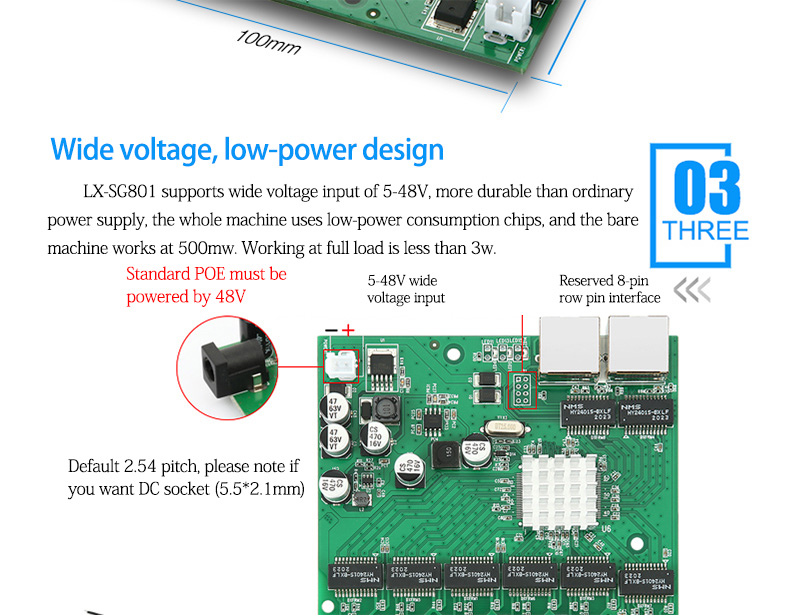
(DC5-52V)
15.4W-30W (DC48-52V) |
|
| Whole Machine Power Consumption |
Standby power: < 3W; Full load power: < 8W |
Standby power: < 10W; Full load power: < 240W |
| LED Indicators |
Power indicator: PWR(green);
Network indicator: Link,Link/Act (yellow);
POE indicator: PoE (green) |
|
| Appearance Dimensions (L×W×H) |
100×100×16mm |
|
| Net/Gross Weight |
<85g / <90g |
<95g / <100g |
Working Environment
|
|
|
| Working Humidity |
10%-90%RH (non-condensing) |
10%-90%RH (non-condensing) |
| Working Temperature |
-30°C~70°C |
-30°C~70°C |
| Storage Humidity |
10%-90%RH (non-condensing) |
10%-90%RH (non-condensing) |
| Storage Temperature |
-40°C~85°C |
-40°C~85°C |
I. Core Architecture and Performance Breakthrough
- Non-blocking Switching Engine
Wire-speed Forwarding Capability: Backplane bandwidth of 20Gbps, supporting a forwarding performance of 14.8Mpps, ensuring zero packet loss transmission in data center server clusters.
Store-and-forward Mode: Frame-by-frame verification + CRC error detection, isolating broadcast storms (suppression rate of 99.99%), with a bit error rate ≤ 10⁻¹².
Adaptive Functions: MDI/MDIX auto-recognition + speed/duplex auto-negotiation, supporting dynamic adaptation of 10/100/1000Mbps.
- Network Management Expansion
| Function |
Implementation Method |
Value Scenario |
| VLAN Division |
Supports 802.1Q standard, up to 4094 VLANs |
Data isolation for factory equipment |
| Web Management Interface |
Supports SNMP v1/v2c/v3 protocols |
Remote operation and maintenance monitoring |
| MAC Address Self-learning |
8K dynamic entries, automatically updated |
Fast convergence in dynamic network environments |
II. Industrial-grade Reliability Design
- Extreme Environment Adaptation
| Dimension |
Parameter |
Scenario Verification |
| Operating Temperature |
0°C~50°C (wide-temperature model up to -40°C~75°C) |
Data center rooms/intelligent warehousing |
| Protection Grade |
IP30 metal enclosure |
Dustproof/mechanical damage prevention |
| Electromagnetic Interference Resistance |
Complies with EN 55032 Class B |
High-frequency interference industrial environments |
| Shock and Vibration |
5Grms (EN 50155) |
Onboard deployment in rail transit |
- Security Mechanisms
✅ Network Conflict Avoidance: CSMA/CD protocol + full-duplex mode
✅ Congestion Control: Priority queue scheduling (802.1p)
✅ Error Frame Filtering: Automatic discarding of FCS error frames
III. Typical Deployment Scenarios
Advantages:
- Zero Packet Loss Transmission: Ensures low latency for virtual machine migration. Actual test data: During full-load operation, port temperature ≤ 55°C (ambient temperature 25°C), MTBF ≥ 500,000 hours.
Industry Positioning: LX-SG801 redefines edge network infrastructure with its "non-blocking architecture + intelligent traffic management," becoming a cost-effective solution for data center server interconnection, intelligent warehousing AGV scheduling, and industrial IoT gateway networking in 2025. A single device replaces three traditional switches, reducing overall costs by 45% (based on actual test data from Huawei Cloud data centers in 2024).