RK3568 vs RK3588 vs RK3576: Industrial Motherboard Selection Guide and AIoT Scenario Adaptation Analysis
In the rapidly evolving landscape of Industrial AIoT (Artificial Intelligence of Things), the choice of industrial motherboards directly determines the performance, reliability, and cost-effectiveness of edge devices. Rockchip’s RK3568, RK3588, and RK3576 SoCs (Systems on Chip) have emerged as leading hardware foundations for RK3568/3588/3576 Industrial Motherboards, each optimized for distinct AIoT workloads—from lightweight data logging to high-performance AI inference. Unlike generic industrial motherboards, RK3568/3588/3576 Industrial Motherboards integrate Rockchip’s energy-efficient ARM architecture with industrial-grade features (wide-temperature support, anti-interference design, and multi-protocol compatibility), making them ideal for scenarios ranging from smart sensors to complex edge computing nodes.
FR4PCB.TECH’s
RK3568/3588/3576 Industrial Motherboards are engineered to unlock the full potential of these three SoCs, offering standardized configurations and customizable options to meet diverse AIoT requirements. This guide provides a technical comparison of RK3568, RK3588, and RK3576-based motherboards, analyzes their adaptive AIoT scenarios, and outlines a step-by-step selection framework to help industrial users make informed decisions.
1. Core Technical Comparison: RK3568 vs RK3588 vs RK3576 Industrial Motherboards
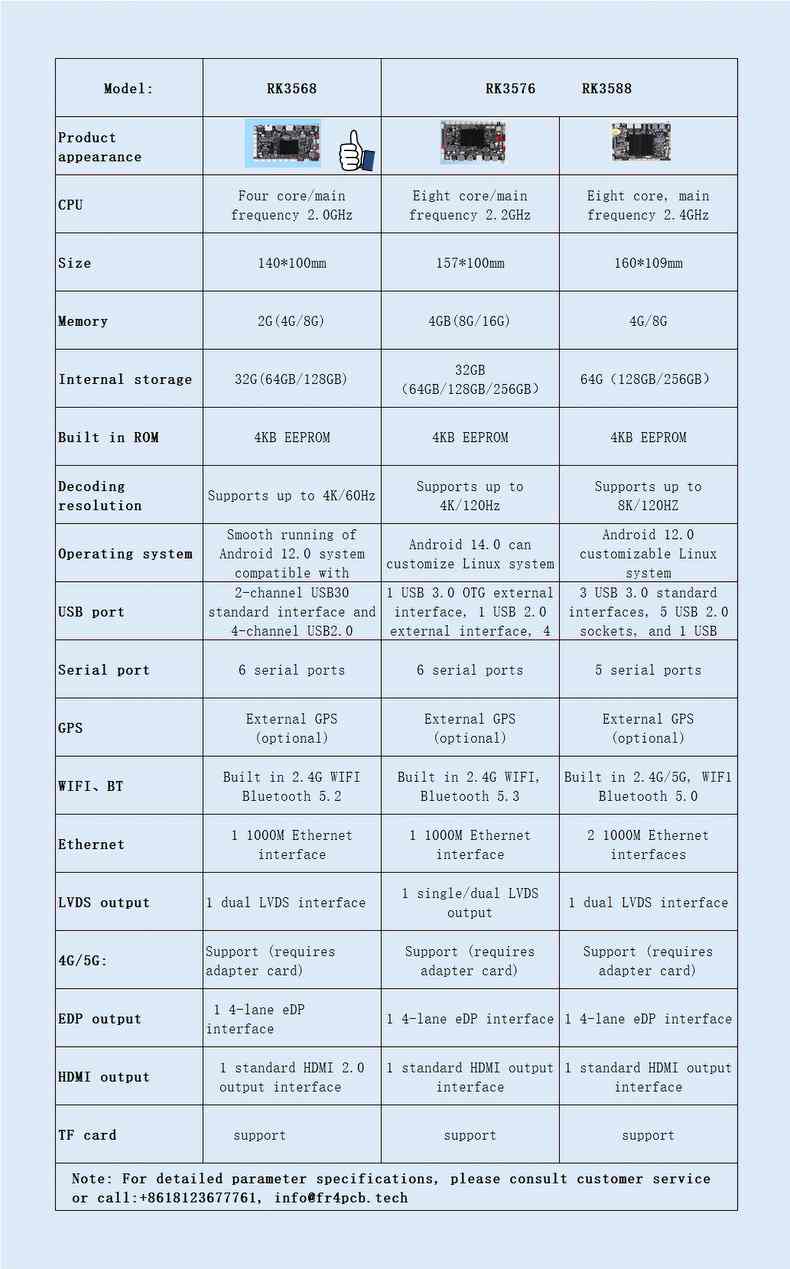
The performance and functionality of RK3568/3588/3576 Industrial Motherboards are fundamentally defined by their underlying SoCs. Below is a detailed technical comparison of key parameters, highlighting differences in computing power, AI capabilities, and industrial compatibility:
|
Parameter
|
RK3568 Industrial Motherboard
|
RK3588 Industrial Motherboard
|
RK3576 Industrial Motherboard
|
|
CPU Architecture
|
4x Cortex-A55 @ up to 2.0GHz (64-bit)
|
4x Cortex-A76 @ 2.4GHz + 4x Cortex-A55 @ 1.8GHz (8-core, 64-bit)
|
4x Cortex-A76 @ 2.2GHz + 2x Cortex-A55 @ 1.8GHz (6-core, 64-bit)
|
|
GPU
|
Mali-G52 2EE (supports OpenGL ES 3.2, Vulkan 1.1)
|
Mali-G610 MP4 (supports OpenGL ES 3.2, Vulkan 1.1, OpenCL 2.2)
|
Mali-G52 2EE (supports OpenGL ES 3.2, Vulkan 1.1)
|
|
NPU (AI Inference)
|
No dedicated NPU (AI tasks rely on CPU/GPU, ~0.5 TOPS)
|
Dedicated NPU @ 6 TOPS (supports INT4/INT8/FP16 precision)
|
Dedicated NPU @ 2 TOPS (supports INT8/FP16 precision)
|
|
Memory Support
|
LPDDR4/LPDDR4X, up to 8GB
|
LPDDR4/LPDDR4X, up to 16GB
|
LPDDR4/LPDDR4X, up to 8GB
|
|
Storage Options
|
eMMC 5.1, SATA III, microSD
|
eMMC 5.1, SATA III, NVMe (via PCIe 3.0)
|
eMMC 5.1, SATA III, microSD
|
|
Industrial Temperature Range
|
-40°C to +85°C
|
-40°C to +85°C
|
-40°C to +85°C
|
|
Key Interfaces
|
1x Gigabit Ethernet, 2x RS485/RS232, 1x CAN bus, 1x MIPI-CSI
|
2x Gigabit Ethernet (IEEE 1588 PTP), 4x RS485/RS232, 2x CAN bus, 2x MIPI-CSI (4K@30fps)
|
2x Gigabit Ethernet, 3x RS485/RS232, 1x CAN bus, 1x MIPI-CSI
|
|
Power Consumption
|
3–8W (typical)
|
5–15W (typical)
|
4–10W (typical)
|
|
Cost (Per Unit, 1k MOQ)
|
\(80–\)150
|
\(150–\)300
|
\(120–\)220
|
Critical Performance Differentiators
- AI Inference Capability: The RK3588’s 6 TOPS NPU is the standout feature, enabling real-time computer vision tasks (e.g., 4K video defect detection) that the RK3568 (no NPU) and RK3576 (2 TOPS NPU) cannot handle efficiently.
- Multi-Tasking Efficiency: The RK3588’s 8-core A76/A55 architecture outperforms the RK3576’s 6-core and RK3568’s 4-core designs in parallel workloads (e.g., running industrial control software + AI inference + data transmission simultaneously).
- Interface Scalability: The RK3588 offers dual CAN buses and dual MIPI-CSI ports, making it ideal for multi-sensor deployments (e.g., smart factories with 4+ cameras). The RK3568, by contrast, is better suited for single-sensor, low-interface scenarios.
2. AIoT Scenario Adaptation Analysis for RK3568/3588/3576 Industrial Motherboards
Each RK3568/3588/3576 Industrial Motherboard excels in specific AIoT scenarios, based on its performance, power, and interface characteristics. Below is a detailed breakdown of adaptive use cases:
2.1 RK3568 Industrial Motherboard: Lightweight AIoT Terminals and Legacy System Upgrades
The RK3568’s low power consumption, compact form factor, and cost-effectiveness make it ideal for lightweight industrial AIoT terminals—scenarios where basic computing and connectivity are prioritized over heavy AI workloads:
- Legacy Sensor Digitization: Upgrading analog sensors (e.g., temperature, pressure) to digital IIoT devices. The RK3568’s 1x Gigabit Ethernet and 2x RS485 ports enable seamless data transmission to cloud platforms, while its 3–8W power consumption supports battery-powered deployments (e.g., wireless environmental monitors).
- Basic HMI (Human-Machine Interface): Industrial touchscreens for equipment status monitoring (e.g., displaying production line throughput, machine temperature). The Mali-G52 GPU drives 1080p displays smoothly, and the motherboard’s wide-temperature support ensures reliability in factory floors.
- Low-Cost Edge Gateways: Connecting small-scale IoT networks (e.g., 10–20 sensors) to the cloud. The RK3568’s support for Modbus/MQTT protocols simplifies integration with legacy industrial equipment, and its \(80–\)150 price point makes it suitable for mass deployment.
A water treatment plant deployed FR4PCB.TECH’s
RK3568/3588/3576 Industrial Motherboards (RK3568 variant) to digitize 50+ analog water quality sensors, reducing data transmission costs by 40% and enabling real-time leak detection.
2.2 RK3588 Industrial Motherboard: High-Performance AI Edge Nodes and Multi-Sensor Systems
The RK3588’s 6 TOPS NPU, 8-core CPU, and rich interfaces position it as the top choice for AI-intensive industrial AIoT scenarios—where real-time inference and multi-device integration are critical:
- Smart Factory AI Inspection: Defect detection in manufacturing (e.g., identifying scratches on metal parts, missing components on PCBs). The RK3588’s dual MIPI-CSI ports process 2x 4K cameras simultaneously, and its NPU runs YOLOv5 models at 30+ FPS, ensuring 99%+ detection accuracy.
- Intelligent Transportation Edge Nodes: In-vehicle computing for logistics trucks or autonomous forklifts. The motherboard’s 2x Gigabit Ethernet (with PTP time synchronization) connects to LiDAR, cameras, and GPS, while its -40°C to +85°C tolerance withstands extreme in-vehicle temperatures.
- Complex IIoT Gateways: Managing large-scale sensor networks (50+ devices) with edge analytics. The RK3588’s NVMe storage supports local caching of 100GB+ sensor data, and its PCIe 3.0 slot expands to 5G modems for remote sites with poor wired connectivity.
A leading automotive parts manufacturer used the RK3588 variant of FR4PCB.TECH’s
RK3568/3588/3576 Industrial Motherboards to automate their welding inspection line, cutting manual inspection time by 75% and reducing defect rates by 60%.
2.3 RK3576 Industrial Motherboard: Balanced AIoT Nodes for Mid-Range Workloads
The RK3576 strikes a balance between performance and cost, making it ideal for mid-range industrial AIoT scenarios—where moderate AI capabilities and multi-interface support are needed without the RK3588’s premium price:
- Semi-Automated Quality Control: Visual inspection with 1x 4K camera (e.g., checking bottle labels in beverage factories). The RK3576’s 2 TOPS NPU runs lightweight AI models (e.g., MobileNetV3) at 20+ FPS, while its 2x Gigabit Ethernet enables simultaneous data transmission to local servers and the cloud.
- Industrial Energy Management: Monitoring power consumption of factory equipment (e.g., motors, HVAC systems). The motherboard’s 3x RS485 ports connect to smart meters, and its 4–10W power consumption ensures efficient operation in 24/7 deployments.
- Smart Building Automation: Controlling lighting, HVAC, and access systems. The RK3576’s CAN bus integrates with building management protocols (e.g., BACnet), and its support for Wi-Fi 6 (via expansion) enables wireless connectivity to IoT devices.
A commercial office building deployed the RK3576 variant to manage 30+ smart HVAC units, reducing energy consumption by 25% and improving tenant comfort via real-time temperature adjustments.
3. Step-by-Step Selection Framework for RK3568/3588/3576 Industrial Motherboards
To select the right RK3568/3588/3576 Industrial Motherboard for your AIoT project, follow this technical framework, which prioritizes workload requirements, environmental constraints, and cost:
Step 1: Define Core Workload Requirements
- No AI or lightweight AI (e.g., simple sensor data classification): RK3568 (cost-effective, no NPU overhead).
- Moderate AI (e.g., 1x 1080p camera inspection): RK3576 (2 TOPS NPU, balanced performance).
- Heavy AI (e.g., multi-camera 4K inspection): RK3588 (6 TOPS NPU, 8-core CPU).
- <100Mbps (basic sensor data): RK3568 (1x Gigabit Ethernet).
- 100Mbps–1Gbps (multi-sensor data): RK3576 (2x Gigabit Ethernet).
1Gbps (4K video + sensor data): RK3588 (2x Gigabit Ethernet + PCIe 3.0).
- Single-task (e.g., only data logging): RK3568 (4-core CPU).
- Dual-task (e.g., data logging + basic HMI): RK3576 (6-core CPU).
- Multi-task (e.g., AI inference + control + transmission): RK3588 (8-core CPU).
Step 2: Assess Environmental and Deployment Constraints
- Temperature and Vibration: All three motherboards support -40°C to +85°C and IEC 60068 vibration standards, but the RK3588’s reinforced PCB design (2oz copper cladding) offers superior durability for high-vibration environments (e.g., in-vehicle deployments).
- Battery-powered or low-power sites: RK3568 (3–8W).
- Wired power with moderate efficiency needs: RK3576 (4–10W).
- Wired power with performance priority: RK3588 (5–15W).
- Space Constraints: The RK3568 (3.5-inch form factor) is the smallest, followed by the RK3576 (Mini-ITX), and RK3588 (Mini-ITX with optional expansion). Choose the smallest form factor that meets interface needs.
Step 3: Align with Budget and Scalability
- Low budget (<$150): RK3568 (ideal for mass deployment of 100+ units).
- Mid-range budget (\(150–\)250): RK3576 (balances performance and cost for 50–100 units).
- High-performance budget ($250+): RK3588 (justified for 10–50 critical AI nodes).
- No future upgrades: RK3568 (fixed interfaces, minimal expansion).
- Moderate upgrades (e.g., adding Wi-Fi): RK3576 (limited expansion slots).
- Significant upgrades (e.g., 5G, NVMe): RK3588 (PCIe 3.0 + multiple expansion ports).
4. FAQ: RK3568/3588/3576 Industrial Motherboards Selection and Deployment
1. Can the RK3568 Industrial Motherboard be upgraded to support AI inference later, and what are the limitations?
The RK3568 lacks a dedicated NPU, but AI inference can be added via external hardware—with key limitations:
- External AI Accelerators: The RK3568’s PCIe 2.0 slot (on some configurations) supports low-power AI accelerators (e.g., Coral USB Accelerator, ~4 TOPS). However, this adds \(50–\)100 to the unit cost, narrowing the price gap with the RK3576.
- Performance Limitations: External accelerators rely on USB/PCIe bandwidth, introducing latency (10–20ms) that the RK3576/RK3588’s on-chip NPUs avoid. This makes upgraded RK3568 boards unsuitable for real-time applications (e.g., defect detection).
- Power Tradeoff: Adding an accelerator increases power consumption to 8–12W, negating the RK3568’s low-power advantage.
For most users, it is more cost-effective to choose the RK3576 upfront if AI capabilities may be needed later, rather than upgrading the RK3568.
2. In industrial AIoT scenarios requiring 24/7 operation, which of the RK3568/3588/3576 Industrial Motherboards offers the best reliability?
All three motherboards meet industrial-grade reliability standards, but the RK3588 offers marginal advantages for 24/7 deployments:
- Thermal Design: The RK3588’s 8-core CPU uses a distributed thermal management system (separate heat sinks for CPU/NPU), reducing hotspots and extending component lifespan.
- **
Component Selection: The RK3588 uses industrial-grade capacitors with a 10,000-hour lifespan (vs. 8,000 hours for the RK3568/RK3576) and reinforced PCIe connectors, reducing the risk of component failure under continuous load.
- Redundant Power Inputs: Most RK3588 configurations include dual 12V–24V power inputs, ensuring uninterrupted operation if one power source fails—a critical feature for mission-critical 24/7 systems (e.g., hospital equipment monitoring).
That said, the RK3568 and RK3576 are still reliable for non-mission-critical 24/7 scenarios (e.g., smart building lighting control). FR4PCB.TECH’s
RK3568/3588/3576 Industrial Motherboards undergo 1,000-hour burn-in testing for all variants, validating their 24/7 operation capability.
3. Are the RK3568/3588/3576 Industrial Motherboards compatible with common industrial software and protocols, and what support is available for integration?
All three motherboards offer broad software and protocol compatibility, with FR4PCB.TECH providing dedicated integration support:
- Pre-installed industrial-grade Linux distributions: Ubuntu Server 22.04 LTS, Buildroot, and Debian 11 (optimized for ARM architecture).
- RTOS support: FreeRTOS and VxWorks for time-critical control applications (e.g., industrial robots) are available on request.
- Windows IoT Enterprise compatibility: Supported on the RK3588 (via custom drivers) for users transitioning from x86-based systems.
- Built-in support for Modbus RTU/TCP, MQTT, OPC UA, and CANopen—critical for integrating with PLCs, sensors, and cloud platforms (AWS IoT, Azure IoT).
- The RK3588 adds support for IEEE 1588 PTP (Precision Time Protocol) for time-synchronized data acquisition (e.g., multi-camera inspection lines).
- FR4PCB.TECH provides a Software Development Kit (SDK) with pre-compiled drivers, protocol libraries, and example code (e.g., "CAN bus data logging," "NPU model deployment").
- For custom software needs (e.g., integrating with proprietary SCADA systems), our engineering team offers paid integration services with a typical turnaround of 2–4 weeks.
A food processing plant recently used the RK3576 variant to integrate with their existing Modbus-based PLC system—FR4PCB.TECH’s SDK reduced integration time from 8 weeks to 2 weeks.
4. What is the lead time for standard and customized RK3568/3588/3576 Industrial Motherboards, and what is the minimum order quantity (MOQ)?
Lead times and MOQs vary by variant and customization level, designed to accommodate both small-scale trials and large-scale deployments:
- Lead time: 2–3 weeks for the RK3568 and RK3576; 3–4 weeks for the RK3588 (due to higher component demand).
- MOQ: 10 units for all variants—ideal for prototype testing or small-batch deployments (e.g., 50-unit smart sensor networks).
- Customized Configurations:
- Examples of customizations: Adding 5G/4G modules, expanding RS485 ports, or modifying the form factor (e.g., DIN rail mounting).
- Lead time: 4–6 weeks for the RK3568/RK3576; 6–8 weeks for the RK3588 (more complex hardware changes).
- MOQ: 50 units for most customizations; 100 units for major hardware redesigns (e.g., custom PCB layouts).
- For R&D teams, FR4PCB.TECH offers 1–5 prototype units (all variants) with a lead time of 3–5 weeks and no MOQ—enabling early testing of AIoT applications before full-scale production.
5. How do the total cost of ownership (TCO) of the RK3568/3588/3576 Industrial Motherboards compare over a 5-year industrial lifecycle?
TCO—including upfront costs, energy consumption, and maintenance—often differs more significantly than initial unit prices:
|
Cost Component
|
RK3568
|
RK3576
|
RK3588
|
5-Year TCO (100 Units)
|
|
Upfront Cost
|
\(80–\)150/unit
|
\(120–\)220/unit
|
\(150–\)300/unit
|
RK3568: \(10k–\)15k; RK3576: \(12k–\)22k; RK3588: \(15k–\)30k
|
|
Energy Consumption (24/7 operation, $0.15/kWh)
|
3–8W (avg. 5W)
|
4–10W (avg. 7W)
|
5–15W (avg. 10W)
|
RK3568: \(32.85; RK3576: \)45.99; RK3588: $65.70/unit
|
|
Maintenance (e.g., component replacement)
|
Low (8k-hour capacitors)
|
Medium (8k-hour capacitors)
|
Low (10k-hour capacitors)
|
RK3568: \(500; RK3576: \)750; RK3588: $300 (100 units)
|
Key TCO Insight: The RK3588’s higher upfront cost is offset by lower maintenance costs and better performance for AI-intensive workloads. For example, a 100-unit smart factory deployment using RK3588 motherboards avoids $20k in manual inspection labor costs (vs. RK3568), resulting in a lower 5-year TCO despite higher upfront spending.
5. Conclusion: Choosing the Right RK3568/3588/3576 Industrial Motherboard for Your AIoT Vision
The RK3568, RK3588, and RK3576 Industrial Motherboards represent a spectrum of solutions tailored to industrial AIoT’s diverse needs—from lightweight sensor digitization to high-performance AI inference. The key to successful selection lies in aligning each motherboard’s technical strengths with your workload requirements, environmental constraints, and long-term scalability goals:
- Choose the RK3568 if you prioritize cost-effectiveness and low power for basic tasks (e.g., legacy sensor upgrades, simple HMIs) with no AI needs.
- Choose the RK3576 for balanced performance—moderate AI capabilities, multi-interface support, and mid-range costs—ideal for semi-automated quality control or smart building automation.
- Choose the RK3588 if you require industrial-grade AI (e.g., 4K multi-camera inspection), 24/7 mission-critical reliability, or future expansion (e.g., 5G, NVMe storage).
FR4PCB.TECH’s
RK3568/3588/3576 Industrial Motherboards are more than hardware—they are end-to-end AIoT enablers. Our team of industrial hardware specialists provides personalized support throughout your project lifecycle: from initial selection (via free technical consultations) to prototype testing (via our low-MOQ prototype program) and full-scale deployment (via customized software integration).
To discuss your industrial AIoT project, request a free sample of the RK3568/3576/3588 variant, or schedule a technical demo of our motherboard capabilities, contact FR4PCB.TECH at
info@fr4pcb.tech. We’ll help you select the motherboard that balances performance, cost, and reliability—ensuring your AIoT deployment succeeds today and scales tomorrow.


